
Transforming School Hallways: How Sensory Paths Are Improving Student Behavior and Transitions
Walk down the hallways of many schools today, and you might notice something different—colorful patterns on the floor inviting students to hop, balance, jump, and move purposefully from one destination to another. These aren’t just decorative additions; they’re sensory paths, and school administrators across the country are reporting remarkable improvements in student behavior and hallway transitions since their installation.
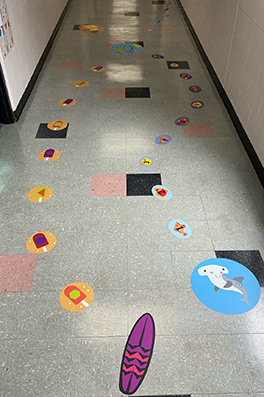
A sensory path transforms a school hallway into an engaging space for movement and learning
What Administrators Are Seeing
The impact of sensory paths on school environments has been striking. School leaders report significant reductions in behavioral issues, with some noting that behavior referrals have decreased dramatically, almost to zero, following the installation of sensory paths. This transformation occurs because these pathways give students constructive outlets for their energy during transitions, rather than allowing that energy to manifest as disruptive behavior.
The improvement extends beyond simple behavior management. Teachers have observed that offering movement breaks through sensory paths between listening and learning activities and academic tasks like writing and math helps significantly reduce classroom interruptions related to behavior. When students can engage their bodies and senses during transitions, they arrive at their next destination more regulated and ready to learn.
The Science Behind the Success
The effectiveness of sensory paths isn’t just anecdotal—it’s grounded in research about how movement and sensory input affect learning and behavior. Studies demonstrate that sensory interventions can decrease behavioral issues and increase learning readiness. For students who struggle with self-regulation skills, sensory regulating activities can increase arousal for those who seem tired or unexcited while calming students who are overstimulated or appear hyperactive.
Research from Children’s Health Council shows that short breaks from classroom activities using sensory pathways can improve cardiovascular health, muscle tone, and cognitive functions like attention and memory. Research has shown that specific movements and their sequences have measurable effects on behavior and learning readiness.
Benefits for All Students
While sensory paths are particularly beneficial for students with autism and other sensory processing challenges, their positive effects extend to the entire student population. Research shows that the ability to regulate the eight senses—sight, sound, taste, smell, tactile, vestibular, proprioception, and interoception—across a wide range of situations helps children be adaptable and learn to control their behavior.
Sensory pathways address these needs by:
- Improving spatial awareness while allowing students to release excess energy constructively
- Supporting sensory integration through different textures, colors, and movements that help children process sensory input more effectively
- Developing motor skills through activities that engage gross and fine motor coordination
- Enhancing focus and attention by providing the sensory input needed for optimal learning readiness
Research-Based Development
Research shows that sensory paths use specific movements, visual cues, joint pressures, and muscle stretches in a particular order designed to stimulate the proper proprioceptive, vestibular, somatosensory, and visual systems. This research-backed approach ensures that sensory paths aren’t just random patterns but carefully designed interventions based on how sensory input affects cognitive processing, attention, and behavior.
Studies on sensory-based interventions have systematically examined their effectiveness for children with behavioral problems, providing evidence that these approaches can make a meaningful difference in school settings.
Creating Calmer, More Purposeful Transitions
Perhaps one of the most visible improvements administrators note is the quality of hallway transitions themselves. Rather than chaotic rushes between classes or restless students waiting in line, sensory paths create structured, purposeful movement. Students become engaged in the physical activities embedded in the pathways—hopping on designated spots, balancing along lines, or following specific movement patterns—which naturally organizes the flow of traffic and reduces opportunities for conflicts or disruptions.
The visible joy students exhibit while using sensory paths is itself noteworthy. School administrators frequently comment on how happy and engaged children appear when following the pathways, suggesting that meeting sensory needs contributes not only to better behavior but also to overall student wellbeing and satisfaction with the school environment.
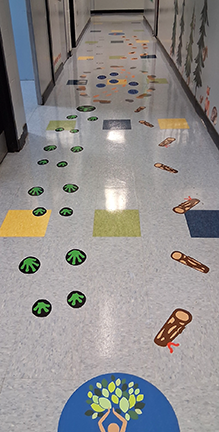
Students love the brain break these paths provide.
Maximizing Existing Resources
From an administrative perspective, sensory paths represent a cost-effective intervention that maximizes available resources. Previously ignored or utilitarian hallway spaces transform into areas full of learning potential at a relatively low cost compared to other school-wide interventions. This efficient use of space aligns with the reality that most schools need to make every square foot count.
According to Edutopia, schools across the country are implementing sensory paths in creative ways, demonstrating that the possibilities for creating movement breaks are endless and adaptable to each school’s unique environment.
Looking Forward
As more schools implement sensory paths and share their positive experiences, this intervention is becoming recognized as a valuable tool in creating supportive, inclusive learning environments. The combination of decreased behavior referrals, improved transitions, enhanced focus, and increased student engagement makes sensory paths an investment that pays dividends in multiple areas of school functioning.
For administrators considering sensory paths, the evidence is compelling: these simple, colorful additions to hallways can fundamentally transform the school day, creating calmer transitions, reducing behavioral disruptions, and supporting all students’ ability to regulate their sensory needs and arrive at learning ready to succeed.
The implementation of sensory paths represents a shift toward proactive, preventative approaches to behavior management and student support—one that recognizes the fundamental connection between movement, sensory regulation, and learning readiness. With research-backed benefits and measurable improvements in school environments, sensory paths are proving to be more than just colorful floor decals—they’re essential tools for supporting every student’s success.