
How Sensory Wall Graphics Transform Children’s Developing Brains
From finger tracing to bilateral integration — the neuroscience behind why interactive wall graphics are one of the most powerful developmental tools in any child’s environment.
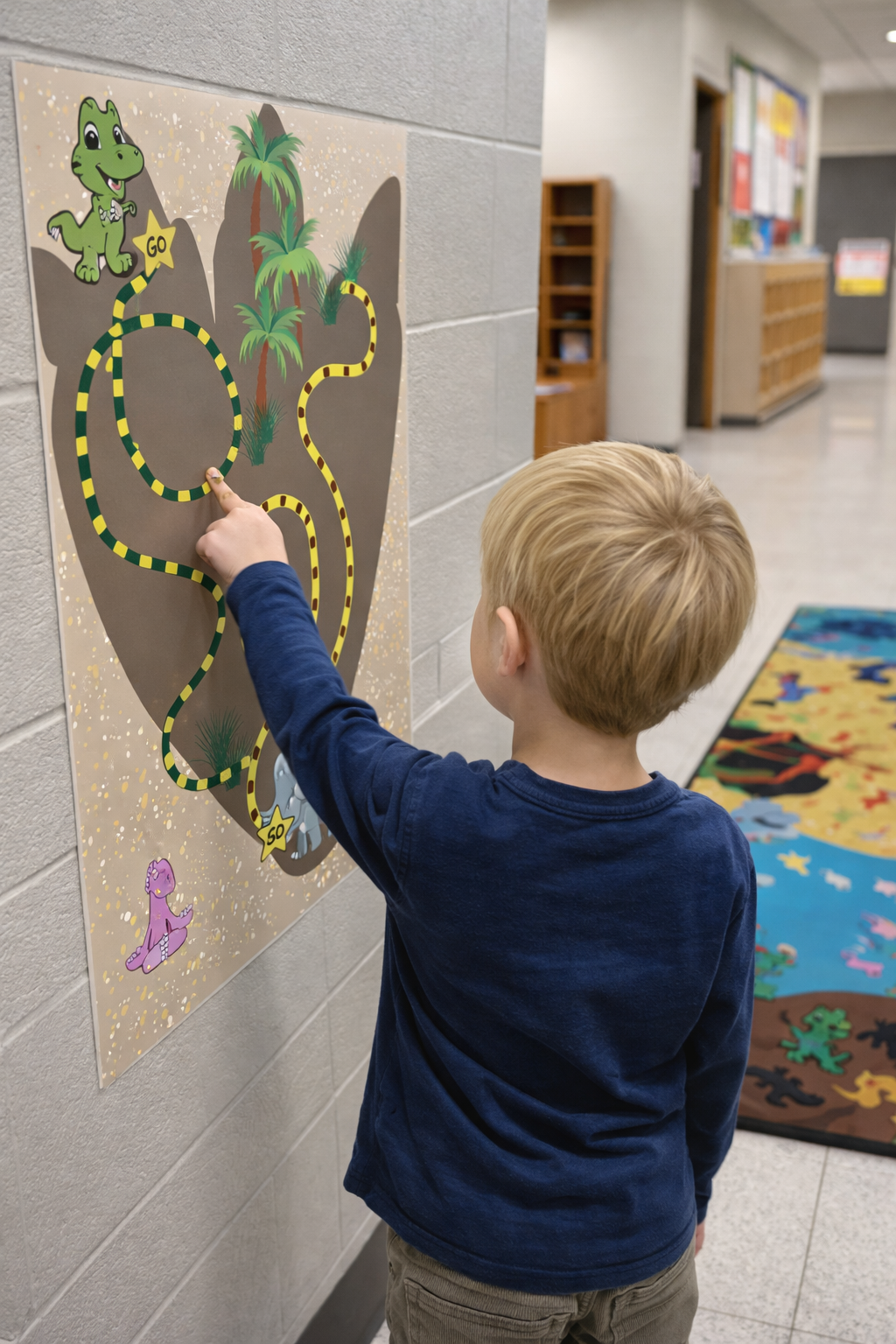
Walk into almost any thriving early childhood classroom, pediatric therapy room, or playful family hallway, and you’ll notice something on the walls — not just decorations, but invitations. Colorful paths, visual shapes begging to be traced, and graphics designed for interaction. These are sensory wall graphics, and they’re far more than a design choice. Behind every swipe of a small finger is a cascade of neurological events that literally shape a child’s developing brain.
This post pulls together what researchers in occupational therapy, developmental neuroscience, and sensory processing science have discovered about why sensory wall graphics matter so profoundly for children’s development — and how they can be used effectively in schools, therapy rooms, and homes.
Neuroscience 101
The Sensory Brain: Why Touch Is a Child’s First Language
Human brains are not born finished. They are sculpted by experience — particularly in the first seven years of life. The principle guiding this process is called neuroplasticity: the brain’s capacity to form, strengthen, and reorganize neural connections in response to sensory input and repeated behavior. As the pioneering neuroscientist
Harvard’s Center on the Developing Child explains, early experiences literally build brain architecture. The connections formed — or missed — in childhood become the scaffolding for all future learning, behavior, and health.
Of all the sensory channels available to young children, the tactile (touch) system is among the most richly connected to higher brain functions. The somatosensory cortex — the strip of brain tissue dedicated to processing touch — contains a disproportionately large representation of the hands and fingers. This means that when a child reaches out and traces a shape on a wall graphic, they are simultaneously activating motor planning centers, language processing areas, spatial reasoning networks, and emotional regulation hubs. Touch is not peripheral — it is central.
“Sensory experiences in early childhood don’t just feel good — they build the physical structures of the brain that govern attention, learning, and emotional resilience for life.”
— Harvard Center on the Developing Child, Foundations of Lifelong Health
Finger Tracing
The Remarkable Power of Finger Tracing
Finger tracing sounds simple — a child follows a line, path, or shape with one finger. But the cognitive and neurological events happening in those few seconds are extraordinary.
Research published in Developmental Psychology and studies from the National Institutes of Health (NIH) have shown that tracing letters and shapes by hand dramatically improves both learning retention and motor skill acquisition compared to visual observation alone. When children trace shapes on sensory wall graphics, they are doing several remarkable things at once:
- Encoding spatial information kinesthetically (through movement) alongside visually
- Strengthening fine motor pathways that will later support handwriting
- Activating working memory by linking movement to form recognition
- Improving letter and number recognition through haptic reinforcement
- Building proprioceptive awareness — the sense of where one’s body is in space
- Supporting visual-motor integration, a foundational skill for all academic tasks
A landmark 2012 study by James and Swain in Trends in Cognitive Sciences found that children who physically traced letters showed significantly stronger letter-specific brain activation in the fusiform gyrus (the brain’s letter-recognition area) than those who simply watched or typed. The act of tracing does something no passive observation can — it carves the learning into neural pathways through multi-sensory engagement.
When children trace along wall-mounted sensory graphics — following pathways, curves, and shapes with their fingers — the act of tracing encodes learning through multiple neural channels at once, reinforcing spatial reasoning and form recognition in ways that passive viewing simply cannot replicate.
Brain Integration
Bilateral Integration: Teaching Both Sides of the Brain to Work Together
One of the most important — and often overlooked — developmental milestones in early childhood is bilateral integration: the brain’s ability to coordinate both sides of the body working together. It is controlled by communication across the corpus callosum, the thick bundle of nerve fibers connecting the brain’s two hemispheres, and is foundational to nearly every complex task a child will ever attempt.
🧠 What Is Bilateral Integration?
Bilateral integration is the neurological ability to use both sides of the body simultaneously and in a coordinated way. It underpins skills like reading (left-to-right eye tracking), writing, tying shoes, catching a ball, playing an instrument, and even walking in a heel-to-toe pattern. Children with bilateral integration challenges often struggle academically, socially, and physically — frequently without anyone understanding why.
According to research from the American Occupational Therapy Association (AOTA), bilateral integration develops through repeated, purposeful movement — particularly activities that cross the body’s midline. The midline is an imaginary vertical line running from head to toe, and when children reach across it (say, tracing a large curved pathway from their left side to their right), they are exercising the exact neural bridges that develop bilateral coordination.
Sensory wall graphics that extend across the full breadth of a child’s reach are uniquely positioned to support this. Unlike a worksheet that sits in front of one hand, a wide wall panel encourages natural midline crossing — especially when the tracing path curves, zigzags, or spirals from one side of the body’s midline to the other.
“Activities requiring children to use both hands simultaneously, or to cross their midline in reaching tasks, are among the most effective ways to stimulate corpus callosum development and bilateral neural coordination.”
— American Occupational Therapy Association, Sensory Integration Framework
Occupational therapists have long used crawling, swimming, and rhythmic bilateral activities for this reason. Wall-mounted sensory graphics bring this therapeutic tool into everyday environments — classrooms, hallways, bedrooms, therapy waiting rooms — making developmental practice continuous rather than occasional.
Learning Styles
Tactile and Kinesthetic Learners: The Children the Classroom Often Forgets
Educational research has long acknowledged that children learn through diverse modalities. While auditory and visual learners tend to be well-served by traditional instruction, tactile and kinesthetic learners — estimated to comprise 30–40% of the school-age population — often struggle in environments that privilege sitting still and listening quietly.
Tactile learners absorb and retain information most efficiently through touch. Kinesthetic learners need movement and physical engagement to encode new concepts. For these children, sensory wall graphics are not a supplement — they are a primary learning channel.
Research from the Understood Foundation, a leading authority on learning differences, underscores that when tactile and kinesthetic learners are given physical ways to interact with academic concepts, both comprehension and retention can improve dramatically. Rather than fighting a child’s learning style, sensory environments work with neurology instead of against it.
This is particularly crucial for children with dyslexia, ADHD, and autism spectrum differences. The tactile reinforcement provided by physically tracing shapes and following visual paths gives these learners an additional processing pathway — one that researchers at the Child Mind Institute describe as reducing cognitive load by distributing information across multiple neural networks simultaneously.
Sensory Integration
Sensory Processing & Regulation: Building the Brain’s Traffic Control System
Dr. A. Jean Ayres, the occupational therapist who pioneered Sensory Integration Theory in the 1970s, described the brain’s ability to organize sensory information as foundational to all adaptive behavior. When sensory processing is dysregulated, children may be hypersensitive (overwhelmed by ordinary stimulation) or hyposensitive (seeking intense stimulation to feel regulated). Both affect attention, learning, and emotional control.
Sensory wall graphics engage the tactile, proprioceptive, and vestibular systems in a controlled, predictable, and self-paced way. Unlike unpredictable social sensory contact (which can feel threatening to sensory-sensitive children), a wall panel invites on the child’s own terms. The child controls pressure, pace, and engagement. This self-regulated sensory input is what therapists call “organizing” input — it helps the nervous system find its equilibrium.
📋 The Eight Sensory Systems at a Glance
Most people know about the five senses, but neuroscience recognizes eight: tactile (touch), proprioceptive (body position), vestibular (balance/movement), visual, auditory, olfactory (smell), gustatory (taste), and interoceptive (internal body signals). Well-designed sensory wall environments engage multiple systems simultaneously, providing the rich multi-modal input that growing brains are biologically wired to seek.
The STAR Institute for Sensory Processing — the world’s leading research and treatment center for sensory processing differences — emphasizes that consistent, meaningful sensory input embedded in a child’s daily environment produces lasting neurological changes. The key word is consistent. A therapy session once a week is valuable, but a sensory-rich environment that a child engages with daily is transformative.
The key word, as the STAR Institute emphasizes, is consistent. A therapy session once a week is valuable, but a sensory-rich environment that a child engages with daily is transformative. This is the rationale behind bringing sensory wall installations into mainstream spaces — classrooms, hallways, pediatric waiting rooms, and family homes — rather than limiting their use to clinical settings.
Fine Motor Development
Fine Motor Skills & Pre-Writing: The Wall as a Practice Ground
Before a child can hold a pencil and form a letter, they must develop hundreds of micro-skills: hand strength, pincer grasp, wrist rotation, finger isolation, and visual-motor coordination. These skills don’t develop in isolation — they are built through repeated, varied, purposeful movement.
Wall-based tracing activities offer something that table-top fine motor work cannot: vertical surface engagement. When a child traces on a vertical surface (a wall panel), their wrist naturally extends into a neutral position, their shoulder stabilizers engage, and their core activates for postural support. Occupational therapists have long recommended vertical surface work for exactly this reason — it builds the full kinetic chain of fine motor development, not just the fingers.
- Wrist extension improves pencil grip mechanics and handwriting fluency
- Shoulder stabilization reduces fatigue during writing tasks
- Core engagement builds postural endurance for sitting and focused work
- Gravity-assisted proprioception deepens body awareness through the fingertips
- Eye-hand coordination improves as children track their own movements on the wall
Research from OT Practice, the AOTA’s clinical publication, supports vertical surface activities as a best-practice intervention for children with developmental coordination disorder (DCD) and pre-writing delays — with sensory wall panels serving as a particularly effective non-clinical implementation.
Emotional & Social Development
Calm Bodies, Ready Brains: Sensory Walls & Emotional Regulation
A brain that is dysregulated — flooded by anxiety, overstimulation, or sensory hunger — cannot learn. This is not a behavioral issue; it is a neurobiological reality. The brain’s limbic system (the emotional center) must reach a baseline of calm before the prefrontal cortex (the learning and reasoning center) can engage. For many children, especially those with sensory processing differences, ADHD, or trauma histories, this regulation is not automatic.
Sensory wall activities function as a form of sensory diet — structured, purposeful sensory input that helps the nervous system regulate itself. The repetitive, rhythmic motion of tracing a path activates the parasympathetic nervous system (the “rest and digest” state), reducing cortisol levels and anxiety while increasing focus and receptive capacity.
Schools that have installed sensory wall graphics in “calm corners” or transition areas report anecdotally — and increasingly in peer-reviewed case studies — that children arrive at their desks more regulated and ready to engage. The CDC’s child development guidelines recognize sensory-rich environments as supportive of social-emotional milestones, particularly for children with developmental differences.
Vestibular & Proprioception
Beyond Touch: Proprioception, Vestibular Input & Body Mapping
Sensory wall graphics don’t just engage the fingertips — they can activate the entire body. When children reach high and low to follow a path, squat to trace a floor-level element, or lean their full body weight into a wall surface, they are generating proprioceptive input (pressure and stretch through muscles and joints) and mild vestibular stimulation (changes in head position and center of gravity).
These “hidden senses” — proprioception and vestibular processing — are, according to Dr. Ayres’ Sensory Integration Theory and subsequent research at the STAR Institute, among the most powerful regulatory inputs for the nervous system. Children who are sensory-seeking (the child who crashes into everything, hangs off furniture, or can’t stop spinning) are often seeking exactly this kind of deep proprioceptive and vestibular input. Sensory wall activities provide a safe, structured channel for that neurological need.
Additionally, full-body engagement with wall graphics contributes to the development of body schema — the brain’s internal map of where the body is in space. Robust body schema is associated with better motor planning, reduced clumsiness, improved athletic performance, and stronger spatial reasoning skills — all of which emerge from rich proprioceptive and vestibular experiences in early childhood.
Environments That Heal
Designing Therapeutic Environments: From Clinic to Classroom
The therapeutic benefits of sensory wall graphics have traditionally been most visible in clinical settings — pediatric occupational therapy clinics, hospital pediatric wards, and specialized schools. But the real paradigm shift in modern child development thinking is the movement toward embedding therapeutic environments into ordinary spaces: mainstream classrooms, school hallways, pediatric dental offices, libraries, and family homes.
This shift is supported by what researchers call the Universal Design for Learning (UDL) framework, championed by CAST (Center for Applied Special Technology). UDL holds that when we design learning environments for children with the greatest sensory and developmental needs, we create better environments for all children. A hallway with sensory wall graphics isn’t just for the child with autism or sensory processing disorder — it benefits every child who runs their fingers along it on the way to class.
“Sensory-rich school environments don’t just accommodate children with differences — they elevate the learning conditions for every student who passes through them.”
— CAST, Universal Design for Learning Framework
321 Sensory Paths offers design solutions specifically built to translate therapeutic-grade sensory wall experiences into school, therapy, and home environments — developed with the principles of sensory science in mind.
🔗 Further Resources
If you’re looking to bring sensory wall graphics into a classroom, therapy room, or home environment, 321 Sensory Paths offers a range of flat sensory wall graphics designed with developmental principles in mind. Their resource library also includes guidance on installation and use across different settings.
Special Populations
Sensory Walls for Children with Autism, ADHD & SPD
For children with autism spectrum disorder (ASD), attention-deficit/hyperactivity disorder (ADHD), and sensory processing disorder (SPD), sensory wall graphics are more than enriching — they can be genuinely therapeutic. Research from the Child Mind Institute, the Autism Society of America, and published OT literature identifies consistent themes:
Children with ASD frequently demonstrate sensory-seeking or sensory-avoiding behaviors that interfere with daily functioning. Sensory wall panels provide predictable, consistent sensory input that helps autistic children develop self-regulation strategies. The visual structure of pathways also supports the preference many autistic children have for clear, predictable sequences and spatial patterns.
For children with ADHD, the proprioceptive “wake-up” provided by active wall engagement — pressing, tracing, pushing — activates the same neural circuits that medication targets: dopamine pathways associated with sustained attention and executive function. Movement-based sensory input is, in effect, a physiological attention reset.
For children with SPD, sensory walls serve as a form of sensory diet therapy as described by occupational therapist Patricia Wilbarger — providing the specific types of sensory input a child’s nervous system needs to reach and maintain an optimal state of arousal for learning and social engagement.
Implementation Guide
Bringing It All Together: How to Use Sensory Wall Graphics Effectively
Understanding the neuroscience is one thing — implementing it well is another. Here are research-informed principles for getting the most out of sensory wall graphics in any environment:
Height matters. Install graphics that span multiple heights — some at eye level for children sitting, some requiring reaching, some requiring squatting. Varied reaching promotes the full-body proprioceptive benefits described earlier and ensures children of different sizes and abilities can engage meaningfully.
Variety in visual and surface design. When possible, choose graphics with varied visual complexity and pathway shapes — curves, zigzags, spirals, and grids. This ensures broader engagement and keeps children returning to explore new routes and interactions.
Integrate intentionally. Sensory wall time is most powerful when embedded into transitions (between activities), regulatory breaks (when children need to reset), or pre-task preparation (before demanding academic work). Short, consistent engagement is more neurologically beneficial than long, infrequent sessions.
Pair with language. While a child traces, a teacher, therapist, or parent can narrate: “You’re going around the curve — now cross to the other side!” This language overlay adds an auditory processing dimension and reinforces the spatial language that is foundational for mathematics and reading comprehension.
Research References & Further Reading
- Harvard Center on the Developing Child. Brain Architecture and Early Experiences. developingchild.harvard.edu
- James, K. H., & Swain, S. N. (2011). Only self-generated actions create sensori-motor systems in the developing brain. Developmental Science, 14(4), 673–678. NIH PubMed Central
- American Occupational Therapy Association. Sensory Integration and Occupational Therapy Practice. aota.org
- Ayres, A. J. (1972). Sensory Integration and Learning Disorders. Los Angeles: Western Psychological Services.
- CAST. Universal Design for Learning Guidelines. cast.org
- STAR Institute for Sensory Processing. About SPD: Research & Treatment. spdstar.org
- Child Mind Institute. Parents’ Guide to Sensory Processing Disorder. childmind.org
- Understood.org. Understanding Sensory Processing Issues. understood.org
- CDC. Child Development: Learning & Developmental Milestones. cdc.gov
- Wilbarger, P., & Wilbarger, J. L. (1991). Sensory Defensiveness in Children Aged 2–12. Santa Barbara: Avanti Educational Programs.