Let's get moving!
Let's get moving!
Case Study: How a Sensory Path Helped One Child With Down SyndromeMove, Grow, and Thrive
Background
Student: Harper a 5-year-old student with Down syndrome
Setting: Preschool (school-based physical therapy)
Initial Presentation
On initial evaluation, Harper demonstrated:
Gait deviations: wide base of support, decreased push-off, reduced step length
Balance challenges: unable to maintain single-leg stance, difficulty stepping over obstacles without support
Strength: unable to jump clearing the surface
Motor planning: required verbal cues and physical prompting for multi-step motor tasks
School Mobility: required assistance to go up and down the stairs, dropping on the floor during classroom transitions, needed extra time for transitions
Endurance: fatigued quickly during ambulation over 50 ft
Primary Concerns: Decreased balance, lower extremity weakness, delayed motor planning, reduced endurance, difficulty navigating school environment safely
IEP Goals
- Improve dynamic balance to safely navigate hallways and playground surfaces
- Increase lower-extremity strength and motor coordination
- Improve ability to follow multi-step motor sequences
- Improve her endurance and mobility to move through her school environment
Intervention: Implementation of a Sensory Path
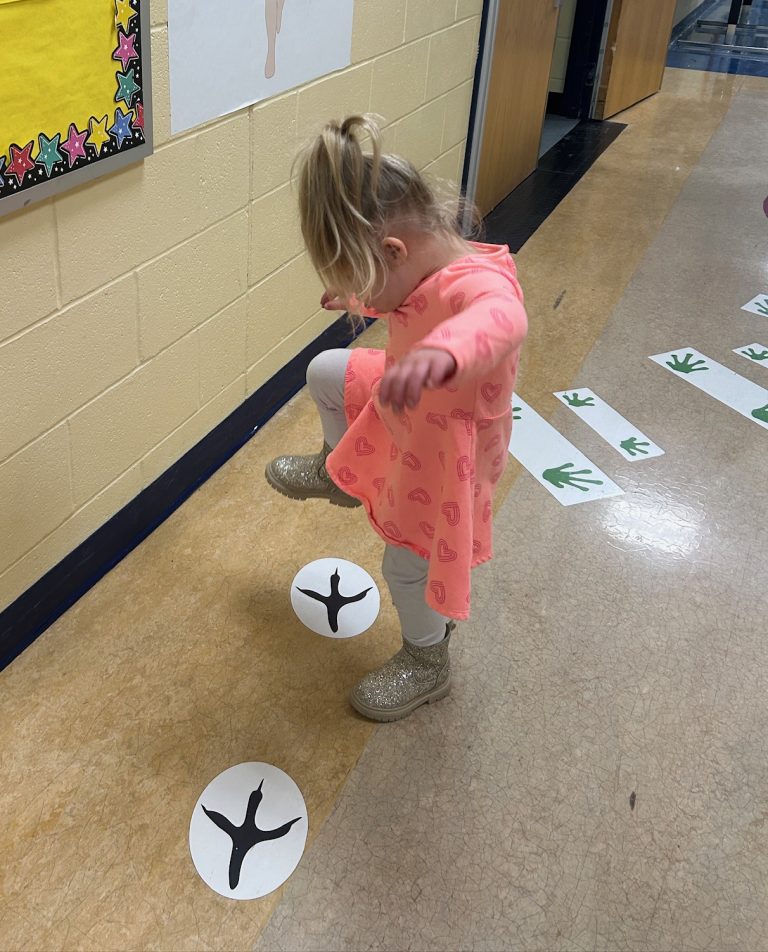
A sensory path was used along the hallway leading to Harper’s classroom. The path included:
Balance-line walk, Log jumping, Frog jumping, Standing on 1 foot, Yoga poses
Therapeutic Rationale
Motor Planning: Sequenced visuals help guide movement initiation
Strength & Endurance: Squatting, jumping, and stepping patterns increase lower-extremity muscle engagement
Balance: Narrow-line walking and controlled stops improve dynamic postural control
Treatment Implementation
Harper used the sensory path 1-2 days per week during morning arrival and before transitions. Physical therapy sessions incorporated:
- Guided trials on the sensory path with fading cues
- Strength-building tasks (step-ups, mini-squats)
- Balance activities (tandem walking, stepping over foam obstacles, practices standing on 1 foot)
- Practice sequencing the path independently
Progress over 8 Weeks
Balance
- Single-leg stance improved from 2 seconds to 5 seconds on each leg
- Demonstrated improved control during walking on a line
- Needed fewer external supports when stepping over obstacles
Strength & Endurance
- Complete the sensory path twice consecutively without fatigue (previously needed rest breaks)
- Increased squat depth and improved hip extension during jumps
- Jumps forward 6”
- Ambulated 400 ft without rest breaks in school environment
Motor Planning & Sequencing
- Initially required continuous verbal and gestural cues
- By week 8, followed the entire 5-step sensory path with only an initial verbal prompt
Functional School Participation
Teachers observed:
- Faster, smoother transitions between classrooms
- Decreased avoidance behaviors
- Improved readiness to participate in academic tasks after completing the path
- Increased confidence and willingness to try new physical tasks
- Needed less support when going up and down the stairs
Conclusion
Outcome Summary
Using the sensory path as part of a structured physical therapy plan resulted in meaningful gains in gross motor skills, including:
- Improved dynamic balance
- Increased lower extremity strength
- Better coordination and motor planning
- Enhanced independence during school transitions
The sensory path provided a motivating, visually supported, and functionally embedded opportunity for repetition of gross motor skills. For this student with Down syndrome, it served not only as a therapeutic intervention but also as a tool for increasing participation, independence, and confidence in the school environment.
Case Study: Colton's Amazing Progress
Colton was born at 34 weeks. He has a diagnosis of spastic quadriplegic cerebral palsy and global developmental delay. He is also visually impaired and has epilepsy. Both hips are dislocated and has scoliosis. At his initial evaluation for school, Colton was using army crawling for his main method of mobility. This video shows Colton visually exploring the sensory rug, locating objects after given a cue and time. The vibrant colors draw his attention and motivate him to move. Colton previously would not crawl on textured surfaces and preferred to use his wheelchair. However, after using our sensory rug he now enjoys exploring the high contrast colors to locate all of the elements.
Why is crawling so important?
Colton can now crawl! He can now sit upright for up to 3 minutes all by himself! He can cruise at a support surface with assistance. He can walk with 2 hand support of an adult. He is now walking for up to 500’ with a gait trainer. He has his own wheelchair and he can propel himself when motivated.
- Crawling is one of the first independent ways of movement.
- It helps to develop and enhance our vestibular and balance systems, sensory systems, cognition, problem solving skills and coordination.
- Helps the left and right side of his body and brain to work together and build coordination
- Crawling also builds binocular vision (the ability to look ahead in the distance, then back down at his hands while crawling
Case Study: Grace in Space!
Grace had a traumatic birth and had a lack of oxygen. Grace is impulsive and can easily become over excited. Our sensory system gives us information regarding the body-emotion connections. Teaching Grace the ability to notice her body’s signals, and connect to emotions then allows her to come up with adaptations to help regulate her actions. Grace can now identify when she needs to take a brain break; the Outer Space Mat is one of her favorites.
All this therapy is happening while Grace imagines she is a meteor!
The alien graphics on the mat that Grace is mirroring, gives her multi-sensory input. Upside down movement helps to regulate and organize our nervous system. It provides vestibular input as well as stretching the low back and hamstrings. Inverting the head can be calming by resetting the brain. It can also help to support attention to task, focus and concentration. Head pushes provide proprioceptive input, which provides feedback to the body and improves body awareness. The triangle yoga pose provides vestibular input, and develops the coordination necessary to transfer weight from one side to the other, increasing strength and core stability.
Did you know these activities are part of Socio-Emotional Learning?
Self regulation is a cornerstone of SEL. We help students make strong connections between their bodies and their minds. It appears this therapy focuses only on developing motor skills and increasing muscle strength. At the same time, however, it greatly improves body awareness and builds self confidence. (See that smile after the spin?) Combining motor skills and cognitive awareness help children grow in all aspects of their lives.
Case Study: Smiling Jack
Within 6 months of using the sensory path (a secret workout) Jack is now able to hop for the first time! He also improved his neck and back range of motion. While using his imagination and distracting from the actual task, Jack completes a full body workout without even knowing it.
The great therapy happening on the path:
Jack works on problem solving while planning his next move and adjusting his body with every change. This body control works on his core strength, balance, and bilateral coordination using both sides of his body together. These combined movements strengthen almost every muscle in the body including his head, neck, shoulders, chest and back, core, glutes, quads, and hamstrings.
Did you know?
Students on our paths students are integrating sensory input from 5 different sensory systems- skin (tactile), muscles and joints (proprioception), inner ear (vestibular), eyes (visual), and even ears (auditory).