The Business Case for Sensory Paths in Hotels | 321 Sensory Paths
Hotel GMs are always looking for the next amenity that drives repeat bookings and five-star reviews. The answer might be on the floor of your lobby.
The Guest Loyalty Crisis Every Hotel Is Trying to Solve
Guest loyalty is the holy grail of hospitality. And the numbers prove why.
Loyal hotel guests spend 22.4% more and stay 28% longer than non-loyalty members. It costs between 5 and 25 times more to acquire a new hotel customer than to retain an existing one. In 2024, hotel loyalty program revenues hit $1.2 billion — and loyalty members accounted for 52.8% of all occupied rooms.
Every hotel is chasing the same guest: someone who books directly, returns annually, and tells their friends. The question is what creates that level of loyalty in the first place.
The answer, according to the research, is emotional connection. Beyond perks, points, and rewards, guest loyalty represents an emotional bond between the guest and your brand — the culmination of an entire guest experience that yields a positive sentiment and repeat business.
For neurodivergent families, that emotional bond is created the moment they walk through your door and realize your hotel actually thought about them.
The Market Hotels Are Leaving on the Table
Here is the data point that should stop every hotel GM in their tracks:
One in every four individuals in the U.S. has a sensory need or an invisible disability, including those with autism spectrum disorder, dyslexia, and attention-deficit disorder. When you factor in their travel companions — spouses, siblings, grandparents — neurodivergent families represent one of the largest underserved segments in hospitality.
And they desperately want to travel. More than 90% of neurodivergent individuals and caregivers in the U.S. planned to travel at least one night in 2024, according to a landmark survey by Hyatt and KultureCity. The demand is there. The question is whether your property is ready to meet it.
Most aren’t. 78% of families with neurodivergent children limit or cancel trips because of concerns about sensory overload or a lack of staff understanding. That represents an enormous number of families actively looking for a hotel that gets it — and coming up empty.
The hotel that gets it earns something money can’t buy: a family that returns every single year because they finally found somewhere safe.
What Happens When Sensory Overload Hits Your Lobby
Picture your busiest Friday check-in. The lobby is full. The line at the front desk is six families deep. Phones are ringing. A family with a neurodivergent child walks through the door.
The noise, the crowds, the unfamiliar environment — it all hits at once. The child begins to dysregulate. Parents, already exhausted from travel, now face a meltdown in a public space. They can’t focus on check-in. The line backs up. The family leaves a one-star review not because your rooms were bad — but because they never felt welcome from the moment they arrived.
This scenario plays out in hotel lobbies across the country every day. And it is entirely preventable.
The Solution: A Sensory Path in Your Lobby
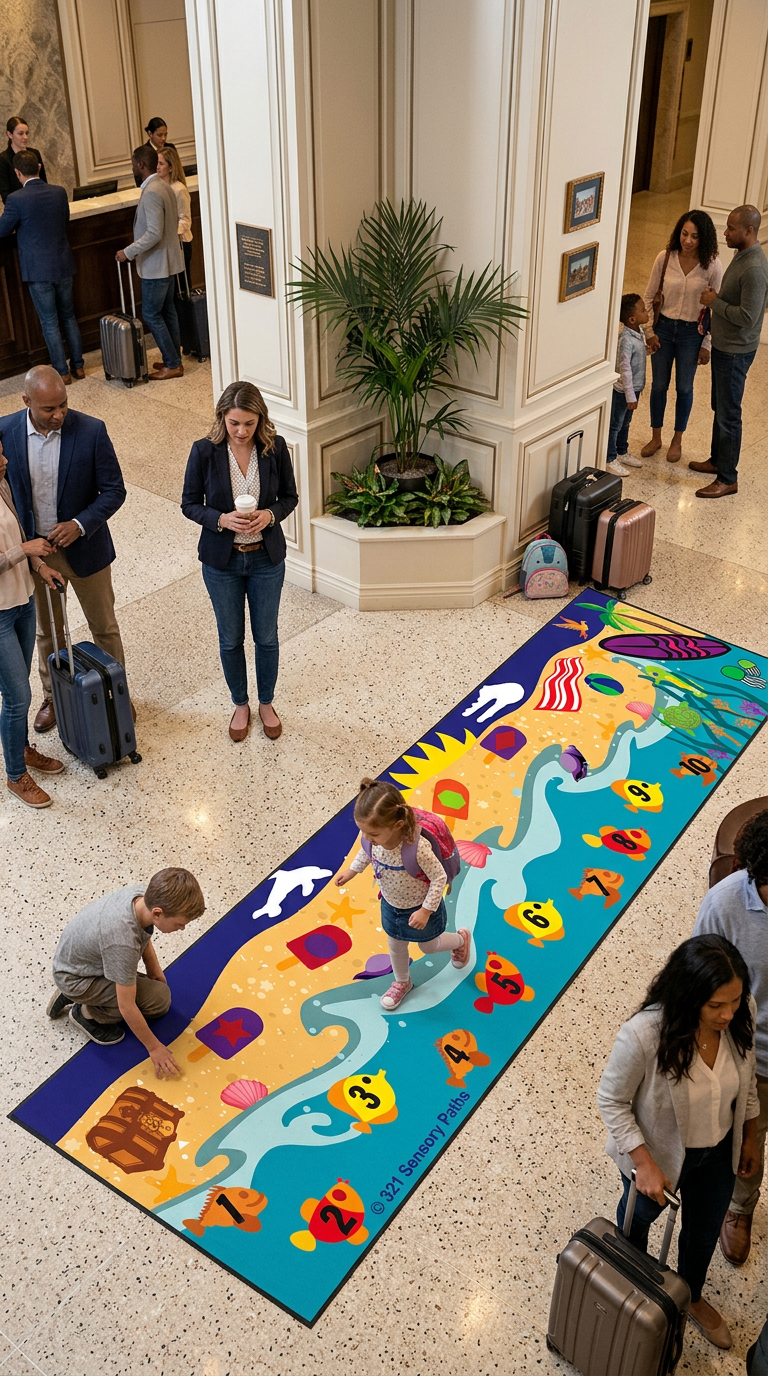
A 321 Sensory Path placed in your lobby gives neurodivergent children a structured, play-based movement activity right at check-in. Designed by a pediatric physical therapist with over 20 years of clinical experience, each path engages the proprioceptive and vestibular sensory systems — the two systems most responsible for emotional regulation and nervous system calm. Not familiar with what a sensory path actually is? Read our full guide here.
While parents complete check-in, their child is hopping between lily pads, tiptoeing through an asteroid field, or mimicking a yoga pose. The child is regulated. The parents are focused. Your lobby runs smoothly.
The result: calmer kids, smoother check-ins, and a family that specifically seeks out your property the next time they travel.
The ROI Breakdown
Let’s talk numbers — because that’s what drives hotel investment decisions.
Repeat Bookings
Neurodivergent families who find a property that accommodates their child’s needs become among the most loyal guests in hospitality. They don’t comparison shop on OTAs. They book directly, they return annually, and they bring extended family. Experience innovation that creates unique, shareable moments drives emotional loyalty that differentiates successful properties from commoditized competitors. A sensory path is exactly that kind of moment.
Online Reviews
Nearly 70% of neurodivergent caregivers said they would disclose their neurodiversity during the hotel booking process if it meant the hotel could better serve them. These are guests actively looking for properties that stand out — and when they find one, they tell everyone. Parent communities, autism travel groups, and special needs Facebook groups share recommendations constantly. One positive experience generates word-of-mouth marketing that no ad budget can replicate.
Reduced OTA Dependency
The families most loyal to your property book directly — reducing your reliance on OTAs and their 15–25% commission fees. Reducing OTA dependency is one of the primary financial benefits of driving genuine guest loyalty. A sensory-inclusive lobby experience is a direct booking driver.
Competitive Differentiation
The global accessible travel market is projected to reach $135 billion by 2032. Properties that invest in inclusive design now are positioning themselves ahead of a wave that is already building. The hotels that act first own the loyalty of this segment. The ones that follow will be playing catch-up.
What It Costs — and What It Isn’t
A 321 Sensory Path is not a sensory room. It does not require construction, renovation, or a dedicated space. It does not require staff training or a new operational protocol.
It is a portable, therapist-designed floor path that:
- Rolls out in under 60 seconds
- Stores in a closet when not in use
- Requires zero installation
- Is machine washable — built for high-traffic commercial environments
- Can be custom branded with your hotel’s logo and visual identity
Products come in three formats — nylon sensory rugs, rubber sensory mats, and permanent vinyl sticker paths — so properties can start with a single portable mat and scale over time.
The investment is modest. The return — in repeat bookings, direct reservations, and five-star reviews from the most loyal families in hospitality — is not.
What the Industry’s Leaders Are Already Doing
The major hotel brands have seen the data and are moving fast. Hyatt partnered with KultureCity to conduct the industry’s first large-scale neurodivergent traveler survey, committing to expanding sensory-inclusive practices across its properties. Neuroinclusive design is now being identified as a major trend by Hospitality Design magazine, with leading designers citing the responsibility to create spaces that feel safe, intuitive, and welcoming for neurodivergent guests.
Independent and boutique hotels have a unique opportunity here. The major chains are moving at corporate speed. A boutique property can implement a sensory path this week — and start capturing the loyalty of neurodivergent families in their market before the big brands catch up.
The Bottom Line
The business case for sensory paths in hotels is straightforward:
- 1 in 4 guests has a sensory need or invisible disability
- 90%+ of neurodivergent travelers plan to travel this year
- 78% are currently limiting trips due to lack of sensory-inclusive options
- Loyal guests spend 22.4% more and stay 28% longer
- Sensory paths cost a fraction of what a sensory room costs — with immediate, portable impact
The families who travel with neurodivergent children are not looking for perfection. They are looking for a hotel that tried — one that put something on the floor of the lobby and said: we thought about your child before you even checked in.
That hotel gets the five-star review. That hotel gets the repeat booking. That hotel gets the loyalty that no points program can manufacture.
Ready to make your property the obvious choice for neurodivergent families? 321 Sensory Paths are designed by a pediatric physical therapist and available in portable rug, mat, and vinyl formats — all suitable for commercial hospitality environments. Schedule a free 15-minute consultation to find the right solution for your property.
Frequently Asked Questions
What is the ROI of adding a sensory path to a hotel lobby?
The ROI comes through repeat bookings from neurodivergent families — one of the most loyal guest segments in hospitality — reduced negative reviews related to sensory overload incidents, positive word-of-mouth in parent and autism travel communities, and competitive differentiation that drives direct bookings over OTA reservations.
How much does a hotel sensory path cost?
321 Sensory Paths offers portable nylon rugs, rubber mats, and permanent vinyl sticker paths at a fraction of the cost of a full sensory room. There is no construction, no installation, and no permanent commitment required. Contact us for hospitality pricing here.
Do sensory paths only help children with autism?
No. Sensory paths benefit any child who needs movement, focus, or a calming reset — including children with ADHD, sensory processing disorder, anxiety, or typically developing children who are simply overstimulated by travel. They are designed to be engaging for all children.
How is a sensory path different from a sensory room?
A sensory room requires dedicated space, permanent equipment, and significant investment. A sensory path is portable, affordable, and can be deployed in any lobby, corridor, or family suite in under 60 seconds. For hotels that want to offer sensory-inclusive amenities without a major capital commitment, a sensory path is the ideal starting point.
Can a sensory path be customized with our hotel’s branding?
Yes. 321 Sensory Paths offers custom branding options so your hotel’s logo and visual identity can be incorporated directly into the path design — creating a guest experience that is uniquely yours and impossible for competitors to replicate.
Where should a sensory path be placed in a hotel?
The highest-impact placements are hotel lobbies during check-in, family suites, kids clubs, and transition corridors. The lobby placement specifically addresses the peak stress moment for neurodivergent families — the busy check-in period — and turns it into a positive first impression that drives loyalty.