A hood zipped over a face. A student wandering to the front mid-lesson. A boy spinning on the carpet, kicking classmates. That was the first hour of one first-grade class in California, as reported by The Hechinger Report in February 2026.
Her teacher stopped teaching nearly 20 times before the hour was up. And she’s not alone. Elementary teachers across the country say behavior problems in young kids are getting worse.
Kids aren’t choosing chaos. Many are still learning how to read and reset their own bodies. That’s self-regulation, and it can be taught.
What Teachers Are Seeing
The Hechinger Report spoke with teachers and researchers about the rise in challenging behavior. A few findings stand out:
- 76% of elementary school leaders said in a 2025 federal survey that the pandemic is still hurting students’ behavioral development.
- 65% of elementary schools reported educators need more classroom management training, up from 51% in May 2022.
- A New Jersey kindergarten teacher said her students have more trouble controlling their bodies and expressing their feelings than past classes.
The reasons are layered. Many of today’s kindergartners and first graders were babies or toddlers during the pandemic. They’re also facing tougher academic demands, less recess, and more screen time than kids a generation ago.
Teachers want help. And the help kids need most often starts with the body. (We dig into the science in how sensory input improves self-regulation.)
Same Kid, Different Day
Self-regulation is a child’s ability to manage their emotions, attention, and actions to meet the moment. It includes something as basic as controlling their body.
A 2026 study in Developmental Science shows that ability isn’t fixed. Researchers at the University of Bern observed 201 kindergartners 10 times over five days, during both teacher-led and child-led activities.
The finding: each child’s self-regulation shifted a lot from day to day and activity to activity. The researchers say these ups and downs are typical for kindergartners.
That matters for every classroom. The child who sailed through circle time on Monday may need a wake-up on Tuesday, or a cool-down after recess on Wednesday. One routine for everyone won’t always fit. (For more on the early years, see sensory processing and emotional regulation in early childhood.)
Meet the Regulation Team: Self Regulation Activities for Kids
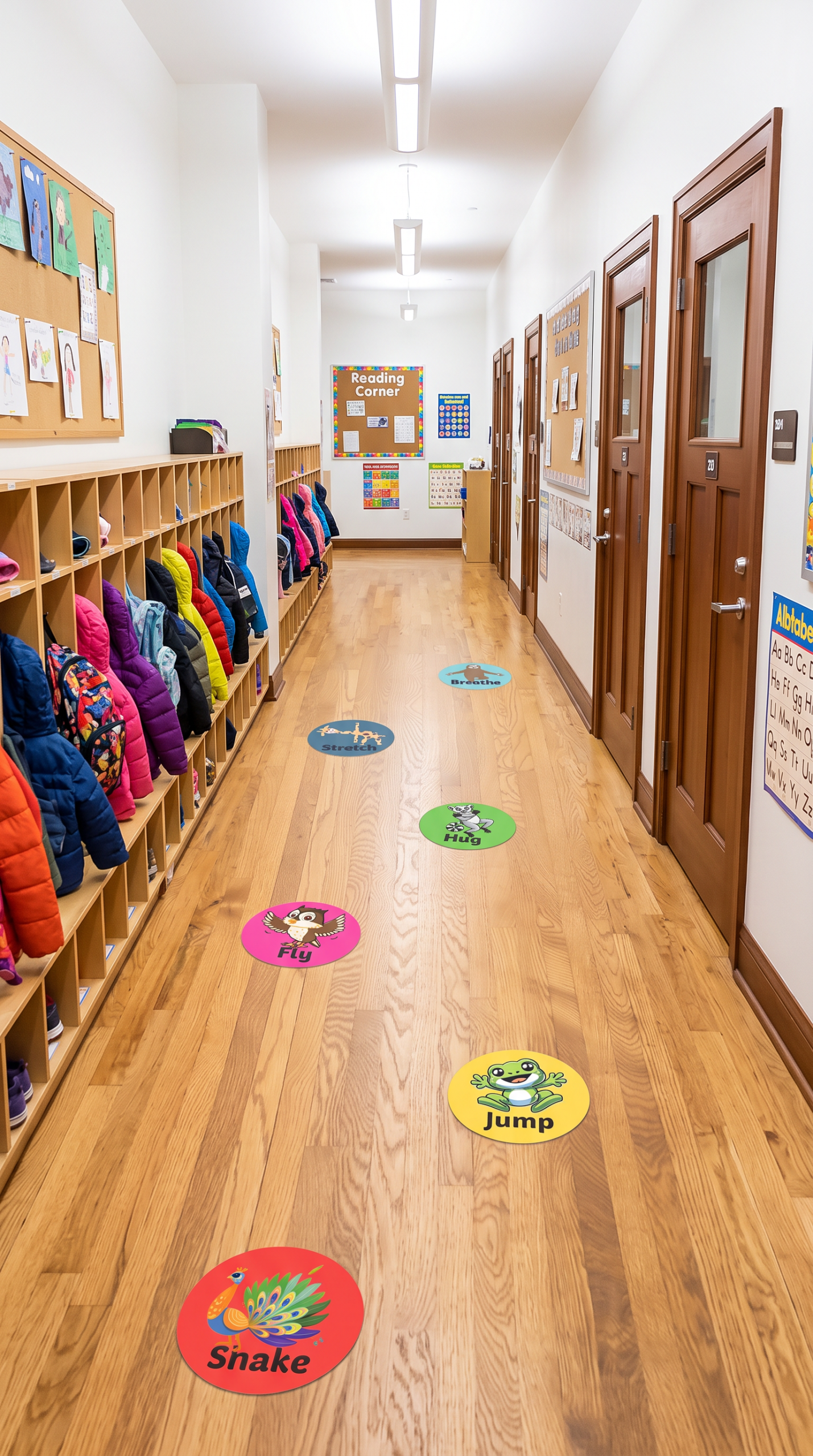
The Regulation Team is six yoga animals that live right on your classroom floor. They’re the same friendly crew from our Ready, Set, Regulate mat, now available as vinyl floor stickers.
The team splits into two squads:
- 3 activating poses for kids who feel sluggish, sleepy, or checked out.
- 3 calming poses for kids who feel wound up, wiggly, or overwhelmed.
Here’s the key: students choose what their body needs. No one-size routine. A child checks in with how they feel, picks a teammate, and does the pose.
The stickers are designed for preschool through 5th grade.
FAQ
What is self-regulation in kids? It’s a child’s ability to manage their emotions, attention, and actions to meet the moment, including controlling their body.
What’s the difference between activating and calming poses? Activating poses help kids who feel sluggish wake up their bodies. Calming poses help kids who feel wound up settle down.
What ages are the stickers for? Preschool through 5th grade.
Where should I put them? Anywhere kids pause during transitions, like the classroom door, the carpet, or the line-up spot.
Further Reading
- Biting, kicking, wandering the classroom: Teachers say there’s a rise in misbehavior even among the littlest kids, Jackie Mader, The Hechinger Report (Feb. 2026)
- Intra-Individual Variability in Children’s Self-Regulation in Kindergarten Classrooms, Kunz & Oeri, Developmental Science (2026)
- How Sensory Paths Improve Behavior and Transitions, 321 Sensory Paths