
The Sensory Arms Race in Hospitality — And Who’s Being Left Out of It
Hospitality has quietly turned into a sensory arms race. Signature lobby scents. Curated soundscapes. Biophilic design, ambient lighting, tactile finishes — properties are competing harder than ever to engineer how a stay feels. Almost all of that investment is aimed at guests without sensory sensitivities.
Meanwhile, a different race is starting on the sidelines. Major hotel chains, cruise lines, and theme park resorts have begun rolling out sensory-inclusive certifications, staff training programs, and dedicated quiet spaces for guests with sensory sensitivities. Some cruise lines have trained their entire guest-facing crew. Some hotel groups have made it a stated brand standard, not a seasonal campaign or a press release moment.
This isn’t an isolated trend at a few flagship properties. It’s a pattern — and patterns in hospitality tend to become expectations fast. The brands moving first aren’t doing it quietly for long; they’re publicizing it, because it works as differentiation. The brands that wait tend to end up playing catch-up on guest expectations they didn’t see coming.
The question for any property watching this happen isn’t should we. It’s how do we do this without a mega-brand budget.
Why the Big Players Are Betting On It
The business case is not soft. One in four guests walking through a lobby has a sensory need or an invisible disability— autism, ADHD, PTSD, dementia, sensory processing differences. More than 90% of neurodivergent travelers and their families plan to travel at least once this year. That’s the guest base the industry leaders are chasing.
The research backs the bet. Peer-reviewed work on multisensory hotel design has found that hoteliers who ignore non-visual senses — sound, light, texture, spatial predictability — do so at the expense of guest experience and ratings. Separately, research on sensory-friendly spaces shows they measurably lower cortisol and support emotional regulation, particularly in environments that tend to overstimulate: crowded lobbies, echoing hallways, bright entertainment zones. Hotels serving families or extended-stay guests are named as the properties with the most to gain.
A calmer kid means a calmer family — and a family that had a smooth stay leaves a better review and comes back. The brands moving first already know that.
Where the Playbook Runs Out
Here’s what the early movers’ playbook is still missing: the how.
Design guides will tell you to build “quiet corners” and “sensory-friendly environments.” They’ll recommend dimmable lighting, sound-absorbing materials, low-sensory rooms. All good advice — and all passive. They describe a space to retreat from stimulation. Almost none of them offer guests a way to actively regulate — to move, reset, and re-engage.
That’s the piece a sensory path adds.
What a Sensory Path Actually Does in a Hotel
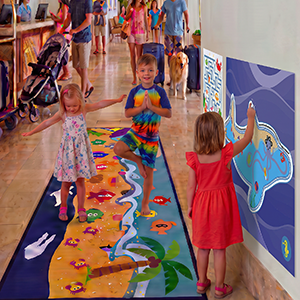
A sensory path is a guided sequence of movement and sensory input — designed to help kids self-regulate through purposeful motion. In a school, it’s used between classes to help kids reset before they walk into a lesson. In a hotel, the same principle applies to traveling families: a child overwhelmed after a long travel day, an overstimulated kid in the lobby while parents check in, a neurodivergent child navigating an unfamiliar environment.
Placed near a family zone, a kids’ club, or a lobby corridor, a sensory path gives young guests something design alone can’t: an active tool, not just a passive retreat. And it gives their parents something just as valuable — a calmer kid, and a few minutes of breathing room.
It’s also one of the most visible, lowest-cost ways a property can signal genuine investment in sensory-inclusive hospitality — not just a certification badge, but something guests can see, use, and remember.
The Window Is Still Open
Right now, the guests without sensory sensitivities have dozens of brands competing for their attention. The guests withsensory sensitivities have a handful. That gap is exactly what makes this a genuine point of differentiation right now, rather than table stakes everyone’s already matched.
That window doesn’t stay open indefinitely. As more brands publicize their sensory-inclusive investments, “we do this too” stops being a differentiator and starts being the baseline guests expect. Properties that move now get to be part of the story the industry is telling. Properties that wait get to explain why they weren’t.
A sensory path isn’t a compliance checkbox. It’s a way to compete in the race that’s just getting started — before it’s simply the cost of entry. See sensory path options built for hospitality spaces.
The science of calm has a name. Let’s bring it to your space.
FAQ
What is sensory inclusive hotel design?
Sensory inclusive hotel design means shaping guest spaces — lighting, sound, layout, and dedicated tools like quiet zones or sensory paths — to support guests with sensory sensitivities, including autism, ADHD, and sensory processing differences, alongside the design choices already made for other guests.
Why should hotels invest in sensory inclusive design?
One in four guests has a sensory need or invisible disability, and more than 90% of neurodivergent travelers and their families travel each year. Research also links sensory-friendly environments to lower guest stress and stronger emotional regulation, both of which drive satisfaction and repeat stays.
How is a sensory path different from a quiet room?
A quiet room gives a guest somewhere to retreat from stimulation. A sensory path is active — it guides a child through a sequence of movement and sensory input that helps them self-regulate, rather than simply removing stimulation.
Where should a hotel place a sensory path?
Common spots are near a kids’ club, a family check-in area, or a lobby corridor — anywhere families with young children spend time waiting or transitioning between activities.
Is sensory inclusive design only for guests with autism?
No. It benefits any child who gets overstimulated or restless during travel — long flights, unfamiliar environments, and disrupted routines affect far more kids than just those with a diagnosed sensory need.