For the millions of families traveling with neurodivergent children, a sensory path can be the difference between a meltdown and a manageable journey. Here’s what they are, why they work, and why the hospitality industry is embracing them.
The Growing Need for Sensory-Inclusive Travel
Travel is inherently stressful — crowded terminals, unfamiliar environments, disrupted routines, and relentless noise. For neurodivergent children, that stress is amplified significantly.
Research published in peer-reviewed journals estimates that sensory processing difficulties affect between 5% and 16% of children in the United States. When you expand that to include children on the autism spectrum — now estimated at 1 in 36 children by the CDC — and those with ADHD, anxiety, and other neurodevelopmental differences, the number of families impacted by sensory overload during travel is substantial.
A 2023 Autism Travel survey found that 78% of families with autistic children limit or cancel trips because of concerns about sensory overload or a lack of staff understanding. Hotels and airports that address this gap are not just being inclusive — they’re capturing a loyal, underserved market.
So, What Exactly Is a Sensory Path?
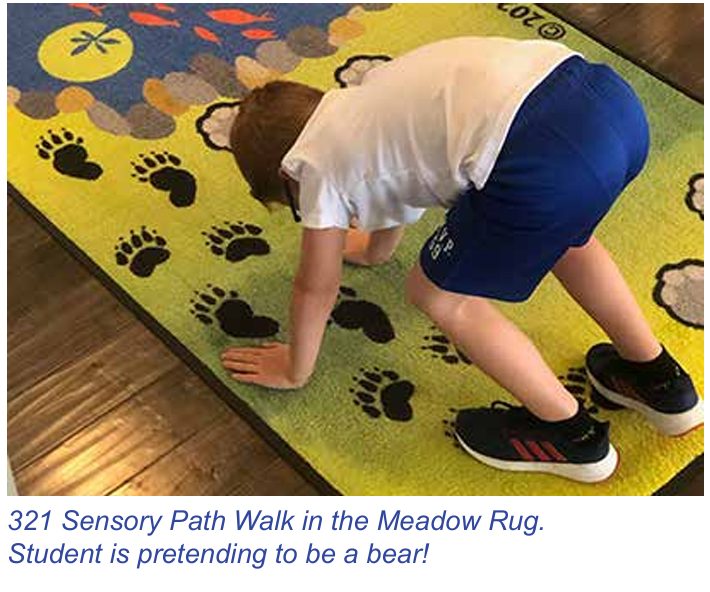
A sensory path is a purposefully designed series of movement activities — printed on rugs, mats, or vinyl floor stickers — that guide children through a sequence of physical exercises. Each activity is crafted to engage specific sensory systems, helping children calm their nervous systems, focus their attention, and regulate their emotions.
Unlike fixed architectural features, modern sensory paths are portable and flexible. At 321 Sensory Paths, products come in three formats:
- Nylon sensory rugs — soft, rubber-backed, machine-washable, and designed to roll up for easy storage
- Rubber sensory mats — compact, durable, and ideal for smaller spaces
- Vinyl sticker paths — adhesive floor graphics that can transform a lobby hallway or corridor permanently
Each product is designed and developed by a pediatric physical therapist with over 20 years of clinical experience, and features colorful, imaginative themes — outer space, ocean islands, meadow walks — that invite children to engage through play rather than compliance.
The Science Behind Why They Work
Sensory paths are grounded in well-established occupational therapy and neuroscience research. Specifically, they engage two critical sensory systems:
The proprioceptive system processes information about where the body is in space — the position and movement of muscles and joints. Research consistently shows that proprioceptive input has a calming, organizing effect on the nervous system, particularly for children with sensory processing differences, ADHD, and anxiety.
The vestibular system governs balance, spatial orientation, and movement regulation. Vestibular input supports spatial orientation and postural stability, while proprioceptive input helps regulate arousal levels and reduce sensory-seeking behaviors.
When a child hops between lily pads, tiptoes through an asteroid field, or mimics a yoga pose illustrated on the mat, they are receiving both proprioceptive and vestibular input simultaneously. Research and clinical practice consistently highlight that vestibular input is best tolerated when paired with proprioceptive input — this combination supports regulation more effectively than vestibular input alone.
The result: a calmer, more regulated child — and a more relaxed family.
Where Do Sensory Paths Fit in Hotels and Airports?
The 321 Sensory Paths hospitality solutions page outlines the environments where sensory paths deliver the most value:
Hotels — Lobbies, family suites, kids’ clubs, and dedicated sensory rooms are ideal placements. A sensory rug or vinyl path gives children an engaging activity during check-in wait times or the long stretch before dinner. Hotels can also incorporate wall graphics — interactive, visual elements designed to encourage breathing, focus, and emotional calm.
Airports — Gate waiting areas, family lounges, and terminal corridors are high-stress zones for neurodivergent children. The open floor space near gates is a natural home for a portable sensory mat that can be unrolled during delays and stored when not needed. Major airports are already investing heavily in sensory-inclusive design: Newark Liberty International Airport opened a post-security sensory room in 2025, and San Francisco International Airport followed with its own dedicated neurodiverse traveler space in December 2024. Minneapolis-St. Paul International Airport has planned two sensory rooms as part of terminal expansions through 2027–2028.
Cruise ships and resorts — Family-oriented vessels and resorts with kids’ programming benefit greatly from sensory paths in activity rooms, kids’ clubs, and transition spaces between activities.
What Does the Hospitality Industry Think?
The hospitality sector is paying close attention. The global sensory-friendly travel market reached over $5 billion in 2024 and is projected to grow at nearly 14% annually through 2033, driven by hotels, airlines, and attractions actively investing in neurodivergent-inclusive experiences.
Hyatt conducted a survey of more than 1,000 neurodivergent individuals and caregivers, finding that over 90% planned to travel at least one night in the coming year — and that hotels have a significant opportunity to serve this market better. The New York Times reported on the growing wave of hospitality brands making meaningful strides for neurodivergent travelers, from sensory rooms to autism-certified staff training.
The data point that hospitality operators find most compelling: guests who feel emotionally connected to a hotel are significantly more likely to be highly satisfied with their stay and to return. Sensory-inclusive amenities create exactly that kind of emotional connection for families who rarely feel genuinely welcomed.
What Makes a Sensory Path Different from a Sensory Room?
A sensory room is a dedicated enclosed space with fixed equipment — fiber optic lights, bubble tubes, crash pads. These are valuable but expensive, permanent, and require significant square footage.
A sensory path is different in three important ways:
- Portable — Unroll it, use it, roll it back up. No installation, no construction, no permanent commitment.
- Scalable — A single mat starts at a modest investment. Additional pieces, wall graphics, or multiple paths across a property can be added over time.
- Flexible — Vinyl sticker paths go anywhere. A nylon rug works in a lobby corner, a family suite, or a dedicated sensory room alongside other equipment.
For properties that aren’t ready for a full sensory room investment, a sensory path is the practical first step — and for many traveling families, it’s all they need.
Custom Branding: A Unique Opportunity
One feature that distinguishes 321 Sensory Paths for hospitality clients is the ability to incorporate custom logos and branding into the path design. A hotel group can offer a sensory path that carries its visual identity — reinforcing brand differentiation and creating a genuinely distinctive guest experience that competitors cannot easily replicate.
Learn more about hospitality-specific sensory solutions at 321 Sensory Paths, or browse all product options to find the right fit for your property.
The Bottom Line
A sensory path in a hotel or airport is a research-backed, portable, and play-based tool that helps neurodivergent children regulate their nervous systems in environments that are typically overwhelming. For hospitality providers, it represents a low-barrier entry point into the fastest-growing segment of the travel market — families who are deeply loyal to the venues that make them feel seen.
The question isn’t whether sensory-inclusive design matters. The question is which properties will lead, and which will follow.
321 Sensory Paths are designed by a pediatric physical therapist and available in portable rug, mat, and vinyl sticker formats — all suitable for commercial hospitality environments. Schedule a free consultation to find the right solution for your property.
Frequently Asked Questions
What is a sensory path in a hotel or airport?
A sensory path is a series of guided movement activities printed on portable rugs, mats, or vinyl floor stickers. Designed by pediatric therapists, they help children — especially those who are neurodivergent — calm their nervous systems through proprioceptive and vestibular input while waiting in lobbies, terminals, and lounges.
How much space does a sensory path need?
Very little. A portable sensory mat can fit in a space as small as a hotel room corner or a gate waiting area. Vinyl sticker paths can be customized to fit any corridor or floor layout. There is no construction or permanent installation required.
Are sensory paths only for children with autism?
No. Sensory paths benefit any child who needs movement, focus, or a calming reset — including children with ADHD, sensory processing disorder, anxiety, or even typically developing kids who are simply overstimulated by travel. They are designed to be engaging for all children.
What is the difference between a sensory path and a sensory room?
A sensory room is a dedicated enclosed space with permanent equipment such as fiber optic lights and crash pads. A sensory path is portable, flexible, and far more affordable. It can be placed anywhere, stored when not in use, and moved between locations — making it ideal for hotels, airports, and cruise ships that want sensory-inclusive amenities without a major construction commitment.
Can a sensory path be customized with a hotel or airport logo?
Yes. 321 Sensory Paths offers custom branding options so hospitality properties can incorporate their logo and visual identity directly into the path design.
How do sensory paths help neurodivergent children during travel?
Travel disrupts routine and floods the senses with noise, crowds, and unpredictability. Sensory paths provide structured movement that engages the proprioceptive and vestibular systems — the two sensory systems most responsible for emotional regulation and nervous system calm. The physical activity redirects a child’s focus and helps them self-regulate before or after high-stress moments like check-in, boarding, or a long wait.
Where can I learn more about sensory path options for my property?
Visit the 321 Sensory Paths hospitality page to explore product formats, view room setups, and schedule a free consultation with a sensory expert.